Avoiding Furniture Damage During Delivery: 2026 Guide
Table of Contents
- What You'll Need Before the Truck Arrives
- How to Inspect Furniture Delivery for Damage
- White Glove Delivery Service Standards to Expect
- Avoiding Furniture Damage: Common Causes and Preventative Packaging
- The Furniture Delivery Damage Claim Process
- Material-Specific Care After Delivery
- Frequently Asked Questions
Last Updated: September 24, 2026
What You'll Need Before the Truck Arrives
Avoiding furniture damage during delivery starts before the truck ever reaches your driveway. Most damage claims trace back to a missing tool or a blocked doorway, not to the carrier.
Here's your checklist for the day before delivery:
- Clear a path at least 36 inches wide from door to room
- Measure every doorway, stairwell, and elevator
- Remove wall art, mirrors, and light fixtures along the route
- Protect hardwood and tile with moving blankets or cardboard
- Charge your phone to full battery for photos
- Print the order confirmation and bill of lading
- Arrange for a second adult to help verify items
- Confine pets to a closed room
The bill of lading is the legal document that lists every item in your shipment. Sign it only after inspection. Once you sign a clean receipt, you weaken your claim for concealed damage later.
Plan for 30 to 60 minutes of inspection time. Rush the process and you'll miss the dent that costs you a replacement.
How to Inspect Furniture Delivery for Damage
Inspect furniture delivery for damage by checking the exterior packaging first, then opening each box to verify the contents. Do this while the delivery crew is still present. Their presence gives you a witness and speeds up any claim.
The 60-Second Exterior Check
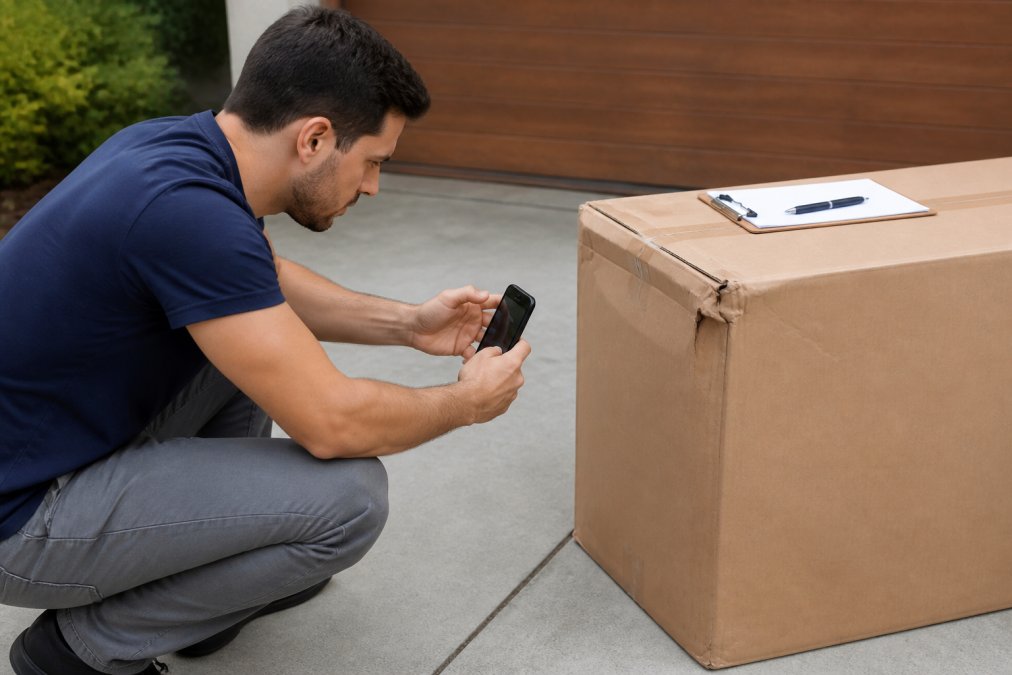
Walk around every box before it enters your home. Look for crushed corners, punctured cardboard, water stains, and tape that's been cut and resealed.
Note any packaging integrity issues on the bill of lading before the crew moves anything inside. Photograph each problem area from two angles.
Then decide: accept with noted damage, or refuse the piece outright. Refusing a visibly damaged item is your strongest protection.
Photographic Evidence That Holds Up
Photos win claims. Vague photos lose them.
Capture these five shots for every damaged piece:
- Wide shot showing the whole item in the room
- Close-up of the damage with a ruler or coin for scale
- The shipping label and tracking number
- The damaged packaging, including the box corner
- A timestamped photo of the bill of lading
Most smartphones embed timestamps automatically. Check that your camera settings have location and time enabled before the truck arrives.
White Glove Delivery Service Standards to Expect
A white glove delivery service standard includes in-home placement, full assembly, packaging removal, and a walkthrough with the customer. If a provider skips any of these, it isn't true white glove service.
Here's what a proper white-glove delivery should include:
| Service Element | What It Covers | What to Verify |
|---|---|---|
| In-home placement | Moving items to the exact room | Crew asks where you want each piece |
| Full assembly | Furniture assembly and leveling | No loose bolts or wobbling legs |
| Packaging removal | Hauling away all boxes and wrap | Nothing left on your curb |
| Damage inspection | Joint review before signing | Crew waits while you check |
| Setup walkthrough | Testing doors, drawers, mechanisms | You operate every moving part |
Orvessa Global offers white-glove delivery, which includes assembly, placement, and packaging removal.
Avoiding Furniture Damage: Common Causes and Preventative Packaging
Avoiding furniture damage during transit comes down to packaging, handling procedures, and route planning. The good news: most causes are predictable and preventable.
Common culprits for furniture damage during transit include:
- Thin corner protection. Edge protectors and foam padding absorb impact at the points most likely to hit a doorframe.
- Loose items in oversized boxes. Movement inside a box causes scratches and cracked joints.
- Improper lifting. Delivery personnel who lift by arms or legs instead of the frame cause stress fractures.
- Weather exposure. Rain and humidity warp wood and stain fabric during loading.
- Stacking pressure. Heavy pieces stacked on lighter ones crush frames and cushions.
For outdoor pieces, material matters. The American Society for Testing and Materials standards for outdoor furniture cover weather resistance and load testing, which is why rustproof aluminum frames and HDPE wicker hold up better than untreated metal.
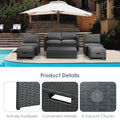
If you're furnishing a rental or hotel, choose fully assembled pieces. The Fully Assembled 8-Person Outdoor Wicker Seating Group arrives ready to place, which removes assembly damage risk entirely. Its rustproof aluminum frame and machine-washable cushion covers handle heavy guest use.
5-Piece Patio Furniture Set with →

The Furniture Delivery Damage Claim Process
The furniture delivery damage claim process typically involves documenting the damage, notifying the carrier, submitting evidence, and tracking the resolution.
Filing Within the Carrier's Window
Carriers set strict reporting windows for freight damage. Visible damage must be noted at delivery. Concealed damage often needs reporting within a short window after delivery, sometimes as little as 24 to 72 hours.
Your claim packet should include:
- Signed bill of lading with damage notes
- Photographic evidence of each damaged item
- Original packaging photos
- Purchase receipt and order number
- A written description of the damage and its cause
- Repair estimate or replacement quote
A Claim Letter You Can Copy
[Date]
[Carrier name] Claims Department [Carrier address]
Re: Claim for damage to [item], Pro number [xxx], BOL [xxx], Delivery date [xxx]
On [date], I received the above shipment. During inspection I noted [describe damage] on the bill of lading. Enclosed are [number] photographs, the signed BOL, the purchase receipt, and a repair estimate of [$ amount] from [repairer].
I am requesting reimbursement of [$ amount] or replacement of the item. Please confirm receipt of this claim in writing within 30 days.
Sincerely, [Name, address, phone, email]
The strongest claims combine a noted bill of lading, timestamped photos, and a same-day report to the carrier. Missing any one of these three weakens your reimbursement odds.
Material-Specific Care After Delivery
Different materials need different care in the first weeks after delivery. Get this wrong and minor transit stress becomes permanent damage. But the highest-value move is earlier: match your pre-delivery prep to the material, because the same doorway that is fine for a fabric sofa can destroy a marble top.
Pre-Delivery Prep by Material
Before the truck arrives, walk the route and think about what is coming through it.
- Marble and stone tops: These are heavy and unforgiving. Clear at least 36 inches of width, pad every corner with moving blankets, and have two people on hand for any piece over 100 pounds. Stone chips at edges, and a chip on a polished edge is visible from across the room.
- Tempered glass: Glass fails at edges, not faces. Inspect the edge for chips before the crew sets it down, and never let a glass top rest on a hard floor without a pad. A hairline edge chip can shatter weeks later from thermal stress.
- High-end upholstery (linen, velvet, boucle): These fabrics snag on doorframes and stair rails. Wrap the route's sharp edges in tape or cardboard, and keep the piece in its plastic wrap until it is in the final room. Packing dust settles into velvet and is hard to remove.
- Solid wood with veneer: Veneer lifts when humidity swings. Let the piece acclimate 24 to 48 hours in the room before placing heavy items, and keep it off heating vents and out of direct sun.
- Metal frames with powder coat: A scratched powder coat is the start of rust. Touch up any nick with matching paint before the piece goes outdoors.
First-Week Care by Material
Wood furniture: Let it acclimate for 24 to 48 hours before placing heavy items. Sudden humidity shifts cause cracking. Keep it out of direct sun and away from heating vents.
Photograph each material's vulnerable point before the crew leaves: the marble edge, the glass corner, the veneer seam. If damage shows up a week later, that pre-delivery photo is the baseline that proves it happened in transit, not in your home.
Frequently Asked Questions
What should I look for when inspecting furniture upon delivery?
Check the outer packaging first for crushed corners, punctures, or water stains. Once opened, inspect all surfaces under good lighting: look for scratches, dents, cracked glass, and seam separation on upholstery. Test moving parts like drawers and recliners. Photograph any damage before the delivery personnel leave and note it on the delivery receipt. Catching issues at the doorstep makes the furniture delivery damage claim process far simpler than discovering problems days later.
What is the difference between standard shipping and white glove delivery?
Standard shipping typically drops boxes at your curb or doorstep, leaving assembly and packaging removal to you. White glove delivery service standards include bringing items inside, unpacking, assembling, placing furniture in your chosen room, and hauling away debris. For large or fragile pieces, white glove service reduces handling risk substantially because trained delivery personnel manage the entire process, and any transit damage surfaces while they are still on site to document it.
Should I refuse delivery if my furniture is damaged?
Not always. Minor cosmetic issues like a small scratch on a leg are often resolved faster with a replacement part than a full refusal, which can delay your project by weeks. For severe structural damage, cracked glass, or a broken frame, refusing delivery and noting the reason on the bill of lading protects you. Either way, photograph everything and get the driver's signature acknowledging the condition before they leave.
How do I document furniture damage for an insurance claim?
Take wide shots showing the item in its room, then close-ups of each damaged area with a ruler or coin for scale. Keep the original packaging and labels. Save your delivery receipt, bill of lading, and any email threads with the retailer. Write a short timeline of events. Most carriers require notification within 24 to 72 hours, so file promptly. A clean photo set and signed delivery receipt are the two strongest pieces of proof of condition.